
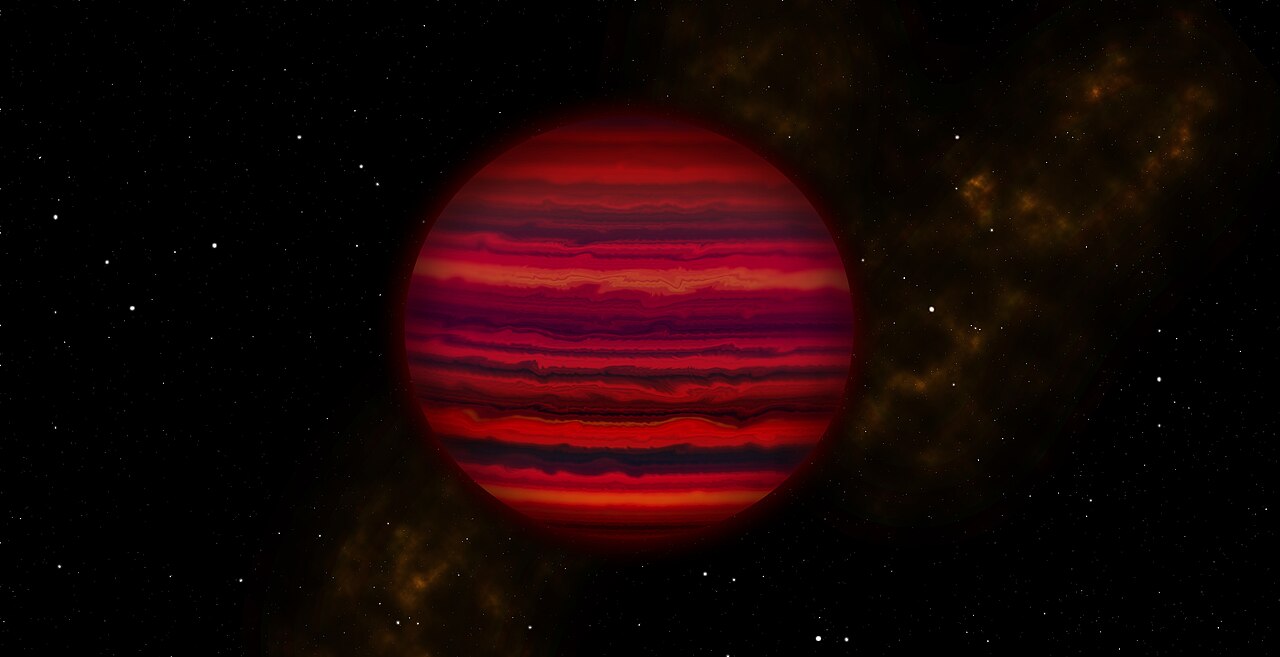
Astronomers using the James Webb Space Telescope have caught weather in the act on one of the coldest known worlds beyond our solar system, finding the first direct evidence that water clouds thicken and thin over time on a nearby brown dwarf.
The target, WISE 0855, sits just 7.5 light-years away — practically next door in cosmic terms — and is the coldest brown dwarf ever catalogued. A team led by Brittany Miles of the University of Arizona’s Steward Observatory spent 11 hours staring at the object, collecting a spectrum of its light every 15 minutes. The result is the most detailed time-series portrait ever taken of such a frigid world.
Clouds that breathe
The observations reveal that water clouds at high altitude grow thicker and thinner as the object rotates, in a rhythm that looks remarkably like weather on Earth. At the same time, deep chemical gases are being dredged upward by convection from far below, and the Webb data allowed the team to untangle the two signals for the first time. Before this, telescopes could only measure combined brightness changes, mixing the effects of clouds, chemistry and temperature together.
“This is the first time we’ve been able to confirm that water clouds are becoming thinner and thicker on a nearby world,” Miles said. The research has been accepted for publication in The Astrophysical Journal and is available as a preprint.
Why brown dwarfs matter
Brown dwarfs are failed stars: they begin life like stars but never accumulate enough mass to ignite steady fusion. They are, however, excellent laboratories for the physics of giant-planet atmospheres, since they share much of the same chemistry without a blinding host star nearby. Learning to read weather on a brown dwarf is therefore a rehearsal for reading weather on directly imaged exoplanets — and eventually, on the temperate rocky worlds that future observatories will target. As coverage of the study notes, the two-process picture of high clouds plus deep convection may become the template for interpreting alien skies. Readers can find more space science in our earlier pieces on a planet born from a dying star and the Artemis II crew’s lunar impact flashes.