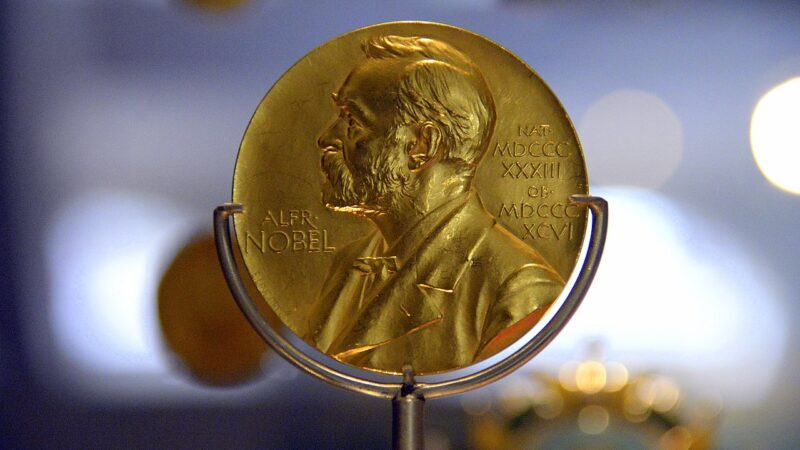

On October 9, 2026, the Royal Swedish Academy of Sciences awarded the 2026 Nobel Prize in Chemistry to Henri B. Kagan of Université Paris-Sud and Kenso Soai of Tokyo University of Science for discovering how tiny imbalances between mirror-image molecules can be amplified into overwhelming one-handedness — work that bears both on how medicines are made and on why life itself is left- or right-handed.
Many molecules come in two forms that are mirror images of each other, like left and right hands. Chemists call them enantiomers, and the body can treat them very differently: one form may heal while its mirror image is inactive or harmful. Making only the useful form, efficiently, is one of industrial chemistry’s standing problems.
Kagan’s breakthrough came in 1986, when he showed that a catalyst’s handedness does not pass to the product in simple proportion. Because catalysts can pair up — two of one hand, two of the other, or one of each — and the mixed pairing often works more slowly, a modest imbalance in the catalyst can produce a far larger imbalance in the product. In the example chemists still cite from his experiments, a catalyst blend of roughly 75 percent one enantiomer and 25 percent the other could drive a reaction yielding about 90 percent of one product form. The phenomenon became known as a non-linear effect, and it gave manufacturers a lever: purity could be amplified rather than merely inherited.
A reaction that copies itself
Soai took the idea further. In 1995 his team found a reaction whose product is itself the catalyst for its own formation — asymmetric autocatalysis. Starting from an excess of just 2 percent of one mirror-image form, the reaction snowballed to 87 percent. By 2003 his group had pushed the amplification beyond 99.5 percent, and later versions could begin from a chance fluctuation with no chiral starting material at all, one hand winning as if by coin toss and then taking over completely.
That last property is why the work reaches beyond the factory. Proteins and sugars in living things are built almost entirely from one mirror form, a puzzle known as biological homochirality. The Soai reaction is the clearest laboratory demonstration that a random microscopic nudge, amplified, could in principle settle such a question — the Nobel organisation has called it one of the most spectacular chemical experiments ever performed.
Kagan and Soai share the 12 million Swedish kronor prize, to be presented in Stockholm on December 10. GlobeNews9’s Health & Science Desk will follow the academy’s full scientific briefing and reaction from the chemical industry.
Related reading: Space Debris Tracking Becomes a Core Part of Orbital Safety · Nobel Week Puts a Price and a Calendar on Scientific Prestige · Artemis II Science Data Release Opens a New Archive From the Moon Flight