
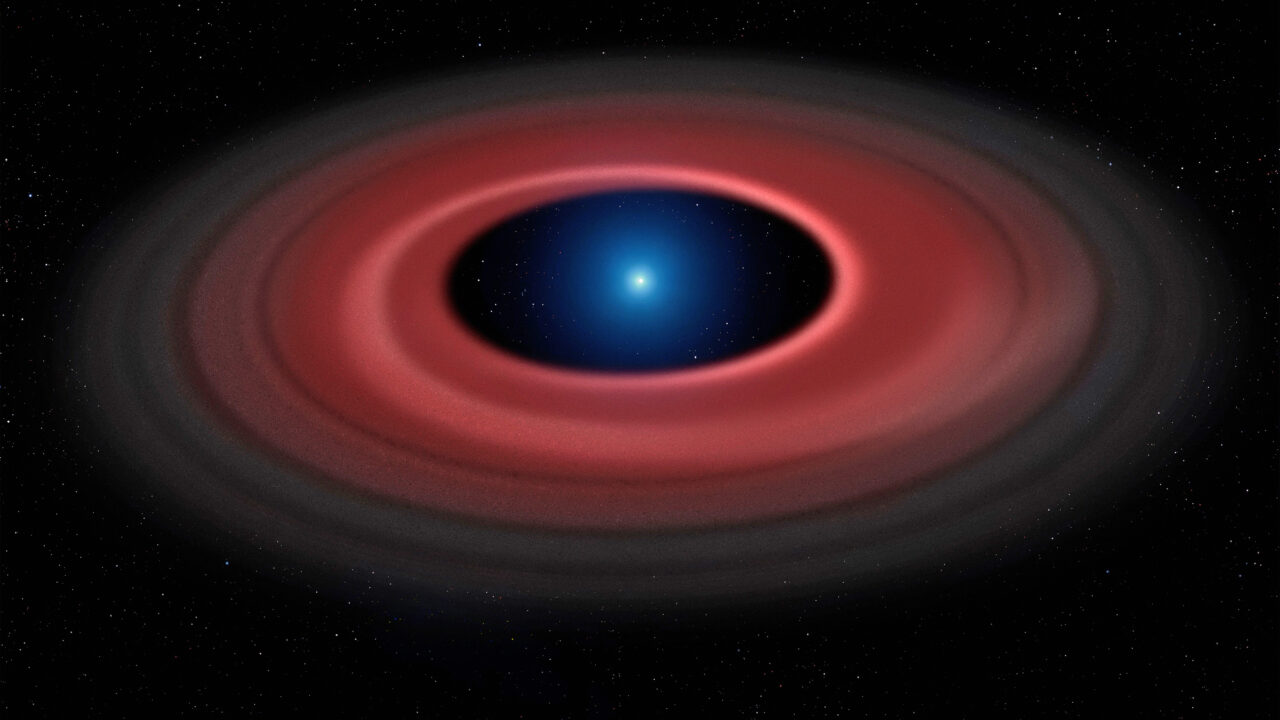
On October 9, 2026, astronomers described a planet that appears to have been born from the wreckage of its own star — a world assembled from material expelled as a sun-like star died, now orbiting the compact white dwarf remnant the star left behind.
Stars a little heavier than the Sun do not go quietly. After exhausting their hydrogen they swell into red giants, shedding their outer layers into space before the exposed core contracts into a white dwarf: an ember roughly the size of Earth holding about half the star’s original mass. Conventional accounts give planets caught in that upheaval two fates — engulfed and destroyed, or flung outward and frozen. A world formed afterwards, condensed from the debris of the death itself, belongs to neither story.
Such second-generation formation is physically plausible. The expelled material can settle into a disc around the white dwarf, and discs are where planets are built; astronomers have already found white dwarfs polluted by the chemical fingerprints of shredded asteroids, and at least one giant planet transiting a white dwarf at close range. What the new system adds, according to the reporting, is evidence consistent with a planet whose very substance postdates the star’s giant phase — less a survivor than an heir.
Why astronomers care
The distinction matters for how common planets may be. White dwarfs are everywhere — the large majority of stars, including the Sun, will end as one — and they are superb natural laboratories: their thin atmospheres record the composition of anything that falls in, letting researchers read the recipe of destroyed worlds. If planets can also form around them, then the era of planet-building in a star system may extend billions of years beyond the star’s main life, and the census of worlds in the galaxy grows accordingly.
The team behind the finding will now look for more such systems, the report says, to learn whether this phoenix planet is a rare accident or the first visible member of a hidden population. Follow-up observations — transits, disc measurements, atmospheric fingerprints — will decide how the claim settles. GlobeNews9’s Health & Science Desk will report the confirmation work as it appears.
Related reading: Space Debris Tracking Becomes a Core Part of Orbital Safety · Nobel Week Puts a Price and a Calendar on Scientific Prestige · Artemis II Science Data Release Opens a New Archive From the Moon Flight